
How to Compare Container Conversions for Global Sourcing?
Comparing container conversions for global sourcing requires more than checking a catalog price. A converted shipping container may become a storage unit, workshop, office, retail space, or technical enclosure. Each purpose changes the required materials, insulation, ventilation, access points, and safety controls. Details matter.
In practical sourcing projects, I have found that similar-looking units can differ greatly after installation. One supplier may use 50-millimeter insulation, while another uses thinner panels with limited thermal performance. Door seals, floor treatment, electrical protection, and drainage also deserve close inspection. Ask for drawings, material specifications, production photographs, and documented quality checks. Reliable manufacturers should explain their process clearly. They should also identify which components are locally sourced and which require longer lead times.
A useful comparison includes conversion cost, transport dimensions, loading methods, installation requirements, maintenance access, and expected service life. Regional climate matters too. A humid coastal site needs different corrosion protection than a dry inland location. Certification and local building requirements must be verified with qualified professionals in the destination market. Do not rely on assumptions.
The cheapest option may create expensive modifications later. That risk is easy to underestimate. I would compare suppliers using the same specification sheet and request itemized quotations. Then, review samples or inspect a completed unit when possible. No comparison is perfect. Some performance claims remain difficult to verify without independent testing. Still, careful questions, traceable documentation, and realistic site planning make container conversions more dependable for international sourcing decisions.
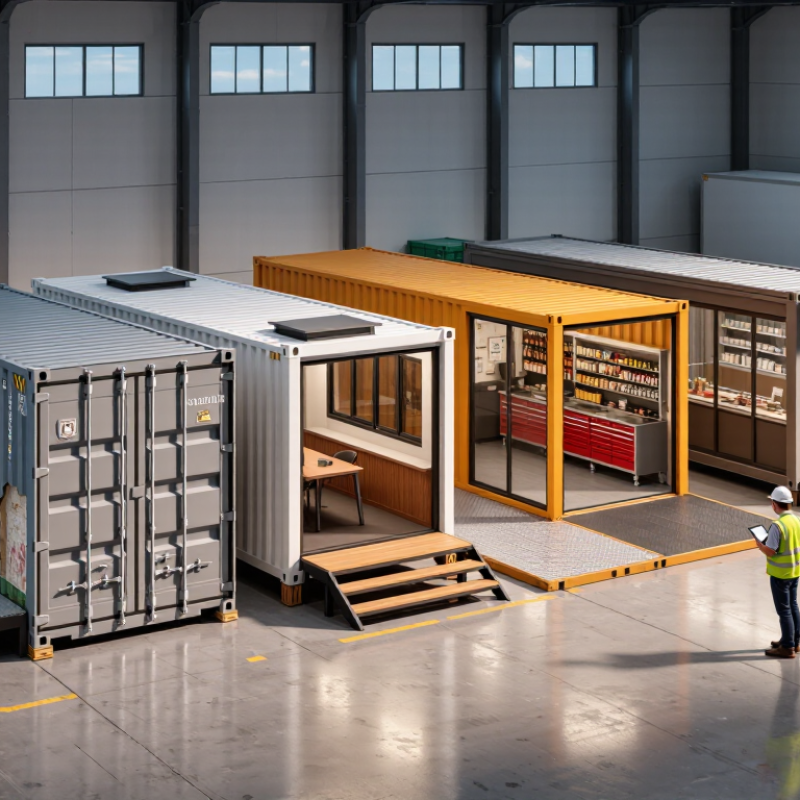
Define Container Conversion Types and Sourcing Requirements
How to Compare Container Conversions for Global Sourcing?
Container conversion begins with a clear type definition. A dry container can become a storage room, workshop, kiosk, or modular office. A reefer container needs different insulation, electrical checks, and temperature-control requirements. Open-top units suit oversized cargo, while tank containers require specialist engineering and certification. These are not interchangeable products.
UNCTAD’s Review of Maritime Transport 2024 reports that maritime transport carries over 80% of global merchandise trade by volume. Therefore, small specification errors can affect delivery, handling, and total sourcing cost across several regions.
Define requirements before comparing suppliers.
Record internal dimensions, payload, floor strength, insulation value, ventilation, door layout, wiring, surface treatment, and expected service life. Ask for material certificates, inspection records, drawings, and photographs from several angles.
The World Bank’s Logistics Performance Index 2023 shows wide differences in customs, infrastructure, and shipment reliability between economies. Your sourcing plan should allow for port conditions, inland transport, local installation, and spare parts.
I have found that a low purchase price often hides expensive modifications. Our first checklist was too neat. Real projects changed it.
Tips:
Compare complete delivered cost, not the conversion price alone. Request one physical sample or inspection before volume purchasing. Check condensation risks inside corners and beneath flooring. Confirm that electrical work follows the destination’s applicable safety standards. A useful scorecard can weight durability, documentation, lead time, repairability, and supplier response speed. Leave room for uncertainty. Forecasts are useful, but they are never perfect.
Identify Key Specifications for Cross-Border Comparison
How to Compare Container Conversions for Global Sourcing?
Identify Key Specifications for Cross-Border Comparison
Comparing container conversions requires more than checking external length and width. Record internal dimensions, door clearance, floor height, payload, and empty weight. A conversion may look identical outside but offer less usable space inside. Measure the loading route too. Forklift access, turning space, and pallet sizes can change the final decision.
Material specifications also need careful review. Check wall construction, corrosion protection, insulation thickness, flooring, ventilation, and drainage points. For electrical systems, confirm voltage, frequency, plug type, power capacity, and wiring documentation. Ask for test reports and drawings, not only product descriptions. Requirements differ between destinations, so local inspection rules and customs documents should be verified early. A neat spreadsheet can still mislead.
Tips: Create one comparison sheet with fixed units. Convert inches, feet, and kilograms before judging prices. Request dated photographs of corners, welds, seals, and underside areas. Confirm whether accessories are included or charged separately. Keep tolerance ranges visible. Small omissions matter.
For cross-border sourcing, compare total delivered cost, not conversion price alone. Include packaging, inland transport, ocean freight, insurance, duties, installation, and possible modifications. Check lead time against production capacity and inspection schedules. A supplier’s clear response is useful evidence, but it is not proof. Independent inspection remains worthwhile. Some specifications may still be uncertain until a physical sample is examined. That is an uncomfortable gap, but ignoring it creates greater risk.
How to Compare Container Conversions for Global Sourcing?
Key internal specifications for cross-border container conversion planning
Standard dry-container dimensions vary slightly by manufacturer and operating region. The comparison uses typical ISO dimensions in metres: a 20-foot container provides compact conversion space, while 40-foot and 40-foot high-cube containers offer greater length and vertical clearance for modular interiors, equipment, insulation, and cross-border packing requirements.
Compare Costs, Quality, Lead Times, and Compliance
How to Compare Container Conversions for Global Sourcing?
Comparing container conversions requires more than checking the lowest quoted price. Start with a complete cost sheet covering materials, labor, inland transport, freight, insurance, duties, installation, and possible rework. A low factory price can become expensive after inspections or destination modifications. Ask suppliers to price the same drawings, dimensions, finishes, insulation, doors, windows, and included equipment. Small specification gaps create large cost differences.
Quality should be measured through evidence, not promises. Request material certificates, production photos, weld inspection records, coating details, and a sample quality checklist. Independent inspections can verify dimensions, moisture protection, electrical work, and structural condition before shipment. Lead times also need careful comparison. Separate fabrication time from approval, inspection, port handling, customs clearance, and final delivery. A supplier promising ten days may not include these stages. That assumption deserves review.
Tips: Use one comparison table for every supplier. Record exclusions clearly. Ask for a realistic production schedule with milestone dates. Confirm how defects will be corrected and who pays for rework. Check compliance with the destination country’s building, electrical, fire, environmental, and transport requirements. Obtain current certificates from qualified authorities, not copied documents. Requirements can vary by use and location. I would also leave contingency time for corrections; early schedules often look too perfect. Quality, cost, speed, and compliance rarely improve together without trade-offs.
Assess Suppliers, Risks, and International Logistics
How to Compare Container Conversions for Global Sourcing?
A reliable comparison starts with the conversion, not the catalogue price. Check the container’s steel condition, floor moisture, weld quality, insulation thickness, doors, ventilation, and electrical workmanship. Ask suppliers for dated factory photographs, material specifications, production tolerances, and a physical sample review. A low quote may exclude reinforcement, inland handling, export packing, or destination installation.
Supplier risk needs equal attention. Review audited financial information, production capacity, worker safety records, quality procedures, and documented corrective actions. The World Bank’s 2023 Logistics Performance Index shows a wide gap between countries in customs, infrastructure, and shipment reliability. That gap can alter delivery planning. UNCTAD’s Review of Maritime Transport 2024 reported that maritime trade grew by about 2.4% in 2023, while disruptions continued to pressure routes and freight capacity. Build time buffers. Not glamorous.
For international logistics, compare total landed cost per usable square metre. Include port fees, chassis or truck access, customs documentation, cargo insurance, storage, and final-mile equipment. Confirm external dimensions, gross weight, lifting points, and stacking limits before booking transport. Modified units may also require destination-specific building, electrical, fire, or transport approvals. Do not assume one certificate travels everywhere. A pilot shipment can expose corrosion, missing fittings, or unclear instructions before a large order. My own preference would be a smaller trial, although it may feel inefficient. A spreadsheet cannot reveal a leaking roof.
How to Compare Container Conversions for Global Sourcing? - Assess Suppliers, Risks, and International Logistics
| Conversion Profile | Product and Supplier Assessment | Cost, Quality, and Production | International Logistics and Risk | ||||||||||
|---|---|---|---|---|---|---|---|---|---|---|---|---|---|
| Typical Base Unit | Common Application | Indicative MOQ | Supplier Evidence to Request | Typical Conversion Lead Time | Main Quality Checks | Tooling or Engineering Requirement | Payment and Inspection Control | Primary Shipping Method | Indicative Transit Time | Key Logistics Risk | Risk Level | Recommended Mitigation | |
| Dry Container Modular Office | 20-foot or 40-foot standard dry container | Site offices, security rooms, classrooms, storage units | 1–5 units for customized projects; 10+ units for repeat programs | Factory profile, welding qualifications, electrical test records, completed project references, material certificates | 6–10 weeks after approved drawings and deposit | Dimensional inspection, weld quality, door alignment, roof leakage test, insulation thickness, electrical safety test | Basic engineering; standard layouts usually need limited tooling | Milestone payments linked to drawing approval, production completion, and pre-shipment inspection | Container vessel service using standard dry-container equipment | Approximately 20–45 days port-to-port, excluding inland delivery and customs | Hidden corrosion, inaccurate dimensions, incomplete electrical documentation | Low to Medium | Use a pre-production survey, approve shop drawings, require waterproofing evidence, and inspect before final payment |
| High-Cube Living or Welfare Unit | 40-foot high-cube dry container | Worker accommodation, welfare facilities, kitchens, washrooms | 1–3 units for projects; 5+ units for standardized deployments | Sanitary and electrical installation records, fire-performance documentation, load calculations, sample approval | 8–14 weeks depending on plumbing and interior fit-out | Fire-stopping, plumbing pressure test, insulation performance, ventilation, flooring adhesion, electrical protection | Moderate engineering; plumbing, HVAC, and fire systems require coordinated design | Hold back a final payment percentage until functional testing and punch-list closure | Standard container vessel service; specialist handling may be needed at the project site | Approximately 25–50 days port-to-port | Local building-code mismatch, water-system damage, condensation, overweight shipment | Medium | Confirm destination regulations before production, obtain a verified weight certificate, and perform a factory acceptance test |
| Refrigerated Container Cold Room | 20-foot or 40-foot reefer container | Temperature-controlled food, pharmaceutical, and laboratory storage | 1–2 units for pilot projects; 3+ units for network deployment | Temperature-mapping report, refrigeration service records, refrigerant information, calibration certificates, emergency-response procedure | 8–16 weeks, including refrigeration commissioning | Temperature uniformity, alarm operation, door-seal integrity, compressor performance, defrost cycle, backup-power interface | High engineering; refrigeration controls and insulation details must be validated | Use staged payment with commissioning evidence and independent temperature verification | Reefer vessel service or specialized equipment transport | Approximately 20–45 days port-to-port; power availability must be confirmed during handling | Temperature excursion, power interruption, refrigerant leakage, inadequate monitoring | High | Install independent data loggers, define temperature limits contractually, arrange backup power, and insure the cargo |
| Open-Top Machinery Conversion | 20-foot or 40-foot open-top container | Industrial equipment housing, generators, pumps, and oversized machinery | 1 unit for engineered projects; 2–5 units for repeat equipment programs | Structural calculations, lifting-point certification, machinery interface drawings, weld procedure records, coating specification | 7–13 weeks after equipment dimensions and load paths are approved | Floor load capacity, lifting points, structural deflection, corrosion protection, access clearance, vibration controls | High engineering; structural reinforcement and equipment anchoring are project-specific | Require design freeze, third-party dimensional inspection, and release only after load-test documentation | Container vessel service if dimensions remain within handling limits; breakbulk may be required otherwise | Approximately 25–55 days port-to-port, plus possible transshipment delays | Incorrect center of gravity, lifting failure, cargo over-dimension, inadequate lashing | High | Approve a certified lifting and lashing plan, verify the center of gravity, and confirm carrier acceptance before dispatch |
| Flat-Rack Platform Conversion | 20-foot or 40-foot flat-rack container | Oversized machinery, steel assemblies, construction modules, and heavy project cargo | 1 unit per project is common; larger quantities require confirmed carrier allocation | Verified cargo dimensions and weight, lashing calculations, lifting plan, corrosion-control plan, carrier acceptance record | 6–12 weeks for the platform; longer when cargo-specific fixtures are required | Deck strength, twist-lock condition, lashing points, weld inspection, dimensional accuracy, load distribution | High engineering for heavy or irregular loads | Use a transport-specific purchase order and require cargo-securing approval before final payment | Specialized container service or breakbulk vessel depending on width, height, and weight | Approximately 30–65 days port-to-port | Carrier rejection, port handling restrictions, cargo shift, demurrage, weather exposure | High | Obtain a route survey, reserve equipment early, use marine-grade protection, and budget for port storage contingencies |
| Tank Container Process Unit | Standard intermodal tank container, commonly 20-foot frame | Non-hazardous liquids, food-grade liquids, chemicals, and process materials | 1–3 units for project use; recurring demand is usually required for better pricing | Tank inspection certificate, pressure-test record, material compatibility statement, valve documentation, cleaning certificate | 8–18 weeks depending on tank specification and regulatory requirements | Pressure test, leak test, valve operation, grounding continuity, internal cleanliness, material compatibility | Very high engineering for hazardous, heated, or specialized fluids | Use documentary payment controls and release funds only after certificates match the tank serial record | Tank-container shipping on approved routes; dangerous-goods rules may apply | Approximately 25–60 days port-to-port, subject to regulatory and terminal acceptance | Incorrect classification, contamination, pressure failure, rejected documentation | High | Confirm product classification, use an independent inspection body, verify destination acceptance, and maintain emergency procedures |
| Retail or Exhibition Showroom | 20-foot or 40-foot standard dry container | Pop-up stores, exhibition spaces, ticket offices, and mobile displays | 1–10 units depending on campaign scale | Finish samples, color and material approvals, electrical test reports, installation drawings, packaging and assembly instructions | 7–14 weeks, with additional time for graphics and custom finishes | Surface finish, color consistency, fold-out mechanism, lighting, electrical safety, packaging protection | Moderate engineering; folding structures and customer-facing finishes need prototype approval | Approve a physical or digital sample before mass production; retain payment against damage-free delivery | Standard container vessel service with protected inland transport | Approximately 20–50 days port-to-port | Cosmetic damage, missed campaign date, packaging failure, installation errors | Medium | Use a golden sample, photograph packing stages, specify spare parts, and build schedule contingency into the launch plan |
| Solar-Powered Utility Container | 20-foot or 40-foot dry container with external energy equipment | Remote power, water pumping, communications, and temporary field operations | 1–3 units for field trials; 5+ units for standardized programs | Electrical single-line diagram, battery safety documentation, inverter test results, grounding plan, energy-yield assumptions | 10–18 weeks, including system integration and commissioning | Insulation, electrical protection, battery enclosure, grounding, inverter function, solar-panel mounting, fire safety | High engineering; electrical integration and site conditions affect the design | Link payments to design approval, factory testing, and verified system commissioning | Standard container vessel service for the container; batteries may require additional dangerous-goods controls | Approximately 25–60 days port-to-port | Battery transport restrictions, weather damage, incompatible site voltage, delayed commissioning | High | Confirm battery transport rules, use certified packaging, conduct a site survey, and provide remote monitoring and spare fuses |
Assessment note: Lead times, minimum order quantities, transit times, and risk ratings are indicative planning ranges based on common international container-conversion projects. Actual results depend on design complexity, origin and destination ports, customs requirements, carrier schedules, seasonal congestion, cargo weight, and local installation regulations.
Select the Best Conversion for Global Sourcing Needs
How to Compare Container Conversions for Global Sourcing?
Select the best conversion by matching the container to its operating environment. A converted container may serve as storage, a workshop, or a temporary sourcing office. Start with its external dimensions, internal clearance, payload rating, and door configuration. Measure twice.
For overseas projects, inspect steel condition, floor treatment, insulation, ventilation, and drainage. Salt air can accelerate corrosion near ports. Hot climates need reflective roofing and controlled airflow. Cold regions may require insulated walls and sealed flooring. Electrical systems should match local requirements and include documented testing. It matters.
Compare the full delivered cost, not only the conversion price. Include inland transport, port handling, customs documentation, installation, maintenance, and possible modification fees. A cheaper unit can become expensive after repeated repairs. Ask for material specifications, inspection photographs, test records, and a clear warranty scope. These documents improve supplier accountability.
Practical sourcing reviews should also examine replacement access. Can local technicians repair the doors, wiring, and ventilation equipment? Are standard components available nearby? A highly customized conversion may look efficient but create long delays later. I have found that project teams sometimes overvalue appearance and undervalue serviceability. That judgment deserves another review. Test locally before placing a large order. Small pilot shipments can reveal condensation, loading problems, or unexpected handling limits.
Related Posts
-
Why Shipping Container Construction is the Future of Sustainable Building Solutions
-
How to Choose the Best Sea Container Storage Options for Your Needs
-
Essential Guide to Shipping Container Doors for Global Buyers?
-
2026 How to Choose the Right Shipping Container Doors for Your Needs?
-
Transform Your Space: Innovative Uses for Storage Shipping Containers in Urban Living
-
2026 Best Sea Container Types for Global Buyers?